148970 stories
·
1 follower

9/11 attacks investigations: approaches and hypotheses

1 Share

AI Mode Conversation: 9/11 attacks investigations: approaches and hypotheses

9/11 attacks investigations: approaches and hypotheses

AI Mode reply for 9/11 attacks investigations: approaches and hypotheses

Investigations into the September 11, 2001, terrorist attacks have relied on distinct official, academic, and alternative investigative approaches, evaluating several core hypotheses regarding who was responsible, how the security breakdown occurred, and whether the hijackers received external state support.

1. Official Government and Forensic Investigations

The primary official approach relied on bipartisan congressional mandates, criminal forensics, and specialized engineering analyses to establish the definitive timeline and mechanism of the attacks.

  • The 9/11 Commission Approach: Established by Congress and President George W. Bush in late 2002, the National Commission on Terrorist Attacks Upon the United States focused on intelligence integration, homeland defense, and institutional preparedness. Its approach relied on reviewing sensitive intelligence, interviewing hundreds of witnesses, and examining counterterrorism policies across federal agencies.
  • The FBI's PENTTBOM Investigation: The FBI launched its largest-ever historical inquiry, codenamed PENTTBOM. Operating out of FBI Headquarters, thousands of agents tracked global leads to quickly identify the 19 hijackers and trace their financial transactions and logistical footprints.
  • The NIST Structural Forensic Approach: The National Institute of Standards and Technology (NIST) conducted an engineering-focused investigation. Their approach relied on structural models, physics simulations, and recovered debris to examine how the kinetic impact of the aircraft and subsequent jet-fuel fires compromised the infrastructure, ultimately attributing the collapse of the Twin Towers and 7 World Trade Center to these fires and impacts.

2. Hypotheses Evaluated by Investigators

Investigators tested several major hypotheses concerning the execution and support network of the plot.

  • The Al-Qaeda Operational Hypothesis (Confirmed Consensus): The core hypothesis validated by the 9/11 Commission Report and international intelligence is that 19 operatives from the Salafi-Jihadi group al-Qaeda, directed by Osama bin Laden, carried out a coordinated suicide plot. This hypothesis was corroborated by extensive financial trails, communication logs, and martyrdom videos.
  • The Systemic Intelligence Failure Hypothesis: This approach explored why the U.S. intelligence community failed to disrupt the plot. Investigations exposed massive institutional deficits, including an inadequate analytical pool, a lack of clear threat dissemination guidance, and poor information-sharing between the CIA and FBI regarding operatives already inside the U.S..
  • The External Support and Foreign Government Liaison Hypothesis: A long-running area of active investigation concerns whether the hijackers had an active support network inside the United States, specifically examining links to foreign state nationals. For instance, civil lawsuits brought by 9/11 families have scrutinized individuals like Saudi national Omar Albayumi, who assisted two hijackers with housing and bank accounts. While early commission findings downplayed his involvement, subsequent disclosures—including pre-operational video surveillance of the U.S. Capitol and pilot descent formulas seized from an associate's apartment—have kept open the hypothesis that the hijackers relied on local facilitators.

3. Alternative and Non-Consensus Hypotheses

A disparate community known as the 9/11 Truth Movement rejects the official findings, proposing alternate hypotheses that have been uniformly dismissed by the scientific and investigative consensus.

  • LIHOP (Let It Happen On Purpose): This hypothesis claims that elements within the United States government possessed specific, actionable advance intelligence about the attacks but intentionally permitted them to happen to justify geopolitical military expansion.
  • MIHOP (Made It Happen On Purpose): This hypothesis posits that the attacks were a "false flag" operation actively planned and orchestrated by inside elements within the U.S. security apparatus.
  • Controlled Demolition Theory: Adherents to this theory argue that the structural damage from plane impacts and fires was insufficient to cause the symmetrical collapse of the buildings, claiming instead that explosives or incendiaries were pre-planted in the World Trade Center towers. Peer-reviewed structural engineering bodies and NIST heavily documented the physical progression of the thermal-structural collapses to refute this.

Copied to clipboardFailed to copy to clipboard. Try again later.

  • 9/11 Investigation - FBI.gov

    The PENTTBOM Team coordinated the investigation out of a basement office, where dozens of agents would build a case against those ...

  • 9/11 conspiracy theories - Wikipedia

    LIHOP (let it happen on purpose) or. Core Theories: Controlled demolitions of WTC towers and building 7; a missile strike or no-pl...

  • 9/11 Truth movement

    The 9/11 truth movement encompasses a disparate group of adherents to a set of overlapping conspiracy theories that dispute the ge...

  • National Commission on Terrorist Attacks (.gov)

    National Commission on Terrorist Attacks Upon the United States

    the United States (9-11 Commission) created late 2002 by Congress and President George W. Bush to account for the September 11, 20...

  • September 11 Attacks: Facts, Background & Impact

    19 terrorists from the Islamic extremist group al Qaeda—founded by Osama bin Laden—hijacked four commercial passenger airplanes an...

  • Department of Justice Office of the Inspector General (.gov)

    Special Report: A Review of the FBI's Handling of Intelligence Information Related to the September 11 Attacks (Full Report)

    Deficiencies: Inadequate analytical program, limited FISA use, poor interagency/internal information dissemination, lack of threat...

  • Recently surfaced 9/11 evidence includes video of Capitol ...

    Apr 28, 2025 — Despite the 9/11 Commission concluding Albei was an "unlikely candidate" for involvement, new evidence and expert analysis suggest...

  • Facebook·The Times and The Sunday Times

    What mysteries of 9/11 remain unsolved? A quarter of a century ...

    Sep 11, 2026 — Albayumi, who helped the hijackers secure an apartment and bank account, claimed a chance meeting but possessed a sketch of a plan...

Read the whole story
Michael_Novakhov
1 hour ago
reply
http://michael_novakhov.newsblur.com/
Share this story
Delete

EXCLUSIVE | Leaked emails reveal former German intelligence chief's Mossad links

1 Share

Former German intelligence chief August Hanning is accused of treason and spying for a foreign agency after allegedly obtaining about 2,000 classified BND documents and using them in dealings with intelligence officials from an unnamed foreign country.

Berlin has not publicly named the recipient, but emails obtained by The Cradle reveal a relationship between Hanning and former Mossad director Danny Yatom.

August Hanning headed the BND from 1998 to 2005. He was arrested on 6 October on suspicion of espionage-related offenses. 

Prosecutors allege that Hanning obtained sensitive documents from Manfred D., a former BND employee. The documents reportedly included internal briefings prepared for senior German officials. 

The case has revealed how vulnerable Germany’s intelligence apparatus is to people who exploit their official positions and personal networks for private gain.

Emails between Hanning and Yatom provide a glimpse into those networks

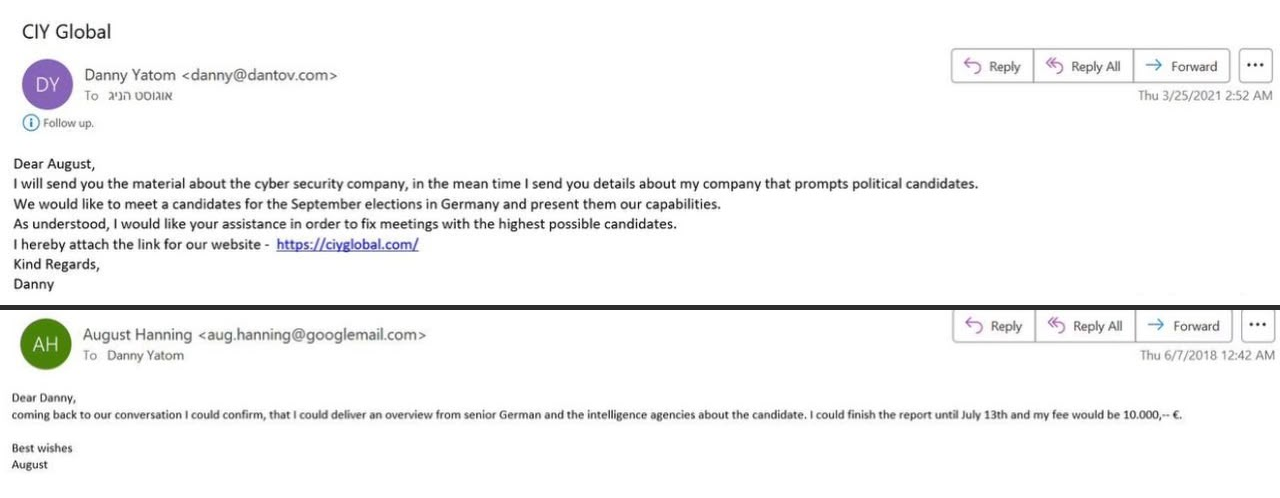
In 2018, Hanning told Yatom he could provide “an overview from senior German and the intelligence agencies about the candidate.” He offered to complete the report by 13 July for €10,000. 

The email does not name the candidate, but the exchange sheds light on the nature of the relationship.

Three years later, Yatom approached Hanning about arranging meetings with senior candidates in Germany’s September 2021 federal election. 

The former Mossad chief wanted to show the candidates what his “political-campaign company”, CIY Global, could do. In the same email, he mentioned material he planned to send about a cybersecurity firm.

Although the emails concern separate matters, together they reveal the relationship: Hanning offered access to German intelligence and political circles, while Yatom built businesses around political influence and cybersecurity.

These were not two former officials who had simply gone their separate ways after leaving public service. Their correspondence reveals an ongoing relationship where intelligence contacts and commercial ambitions intersected.

Their business ties extended beyond political campaigning. Yatom was linked to World Health Energy Holdings, a cybersecurity company where Hanning reportedly served on the advisory side. 

The shadow network connected a former BND chief and a Mossad director through businesses where access to sensitive information and political decision-makers can be highly lucrative.

Israel has built a global market for surveillance, cyber-intelligence and political influence, partly staffed by intelligence veterans. These firms give capabilities developed in intelligence commercial cover and international reach.

Across Europe, impacts are evident. On 12 October, Polish prosecutors said data collected by the Pegasus spyware had been sent abroad and that Israel's NSO Group retained technical access to parts of the system. 

Under Poland’s previous government, Pegasus targeted political opponents and others, exposing the risks of letting an Israeli company access infrastructure used to collect highly sensitive political and personal data.

In Spain, the 2022 CatalanGate investigation documented at least 65 people connected to Catalan politics and civil society who were targeted or infected with Pegasus or Candiru spyware. 

Those affected included politicians, lawyers, and civil society figures. Researchers at the University of Toronto’s Citizen Lab found strong circumstantial evidence linking the campaign to Spanish authorities.

Greece’s surveillance scandal involved targeting journalist Thanasis Koukakis and European Parliament member Nikos Androulakis, along with the use of Predator spyware linked to Intellexa, a company founded by former Israeli intelligence operative Tal Dilian. 

Across these cases, surveillance tools from Israeli-linked firms targeted people whose work and politics challenged those in power.

Israel has established itself as one of the world’s leading exporters of technologies for penetrating phones, monitoring political opponents and obtaining information that would otherwise remain private, while former intelligence personnel have turned their experience into profitable international businesses.

The Hanning affair raises the possibility that this same world of intelligence veterans, private ventures, and political access also played a role in handling Germany’s state secrets. 

The 2018 email shows Hanning offering intelligence-related reporting to Yatom for a fee. 

The 2021 email shows Yatom seeking Hanning’s help reaching senior German political candidates. 

Their cybersecurity business ties add another layer to the relationship. These facts do not establish where the documents at the centre of the espionage case ultimately went, but they give German investigators a concrete reason to examine whether interests linked to Israeli intelligence were involved.

Read the whole story
Michael_Novakhov
2 hours ago
reply
http://michael_novakhov.newsblur.com/
Share this story
Delete

Hamburg Cell operated successfully through strict operational security

1 Share

Hamburg Cell operated successfully through strict operational security

AI Mode reply for Hamburg Cell operated successfully through strict operational security

The Hamburg Cell , allowing them to evade intelligence detection while planning the September 11 attacks. Rather than operating completely in the shadows, they exploited gaps in international law enforcement by maintaining an unremarkable, highly integrated profile in daily German life.

Methods of Operational Control

  • The "Dual-Life" Strategy: The core members—including Mohamed Atta, Marwan al-Shehhi, and Ziad Jarrah—enrolled as engineering and aeronautical students at German universities. They maintained a normal civilian presence, dressed in Western clothing, and interacted naturally with professors and peers to mask their radicalization.
  • Decentralized Logistics: To hide their travels to terrorist training camps in Afghanistan, supporting cell members like Said Bahaji handled their apartments, mail, and university registration. This logistical buffer ensured that core pilots could leave Germany for months at a time without triggering official absences or drawing suspicion.
  • Compartmentalized Communication: The cell largely avoided electronic communications for highly sensitive matters, relying on face-to-face meetings at their shared apartment on Marienstrasse in Hamburg. When digital tools were required, they used shared public terminals or single laptops to execute research, keeping their network narrow.
  • Exploitation of Financial and Legal Gaps: The group capitalized on decentralized international financial structures. They funded flight training and safe houses through legitimate-looking international wire transfers, navigating legal gray areas before the implementation of post-9/11 counterterrorism financial tracking.

German federal investigators and global intelligence agencies only fully uncovered the depth of the Hamburg Cell after the hijackings occurred, leading to an extensive overhaul of European immigration, data mining, and surveillance laws.

Copied to clipboardFailed to copy to clipboard. Try again later.

  • Hamburg cell - Wikipedia

    was a network of Islamist extremist activists based in Hamburg, Germany, pursue higher education in engineering or related fields.

  • Germany's connection to the 9/11 attacks

    Germany passed strict anti-terrorism laws, expanded intelligence and police powers, enabled data-mining searches, and tightened im...

  • Transcript | Inside The Terror Network | FRONTLINE | PBS

    The September 11 attacks were planned and executed by a Hamburg-based Al Qaeda cell led by Mohamed Atta, alongside Marwan al-Shehh...

  • Hamburg cell reveals details - September 18, 2001

    The three suspects known to investigators are Ziad Jarrah, Marwan al-Shehhi and Mohammed Atta. Only after the three men perished i...

  • British Council UK Films Database

    The Hamburg Cell

    The Hamburg Cell is a devastatingly powerful work that puts faces and personalities to the men who carried out the attacks against...

  • The 9/11 hijackers : inside the Hamburg cell | <a href="http://WorldCat.org" rel="nofollow">WorldCat.org</a>

    The group, now collectively known as the Hamburg Cell, was ultimately found responsible for the cultivation of the al-Qaeda plot c...

  • More ties between al Qaeda plotter and 9/11 Hamburg cell ...

    Bahaji and another member of the Hamburg cell, Mounir el Motassadeq, assisted the “core Hamburg cell members” by handling “their a...

  • Alleged 9/11 Mastermind Linked to Hamburg Cell

    Jun 6, 2002 — Khalid Shaikh Mohammed, who authorities now believe conceived the Sept. 11 attacks, apparently met with the terrorist plot's chief...

Read the whole story
Michael_Novakhov
5 hours ago
reply
http://michael_novakhov.newsblur.com/
Share this story
Delete

How 9/11 helped Israel sell its war on Palestinians to America

1 Share

For me, the New York City skyline was close to home. Quite literally. I grew up just across the Hudson River, with the famed skyline of America’s biggest city visible from my bedroom window. Being a Palestinian American living just outside of the world’s most famous city meant that I spent part of my summers as a tour guide for family visiting us from the Middle East, who, like so many people around the world, wanted to see the Big Apple that the movies and live broadcasts from Times Square on New Year’s Eve had made so famous.

I took visitors to the Statue of Liberty, the Empire State Building, Central Park and the World Trade Center. My last tour was in the final days of August 2001. We went to the observation deck of the World Trade Center known as “Top of the World”. Little did I know that two weeks later that deck, where we had stood looking out at the amazing metropolis below, would come crashing down along with the entire World Trade Center, killing thousands and instantly changing the world as we had known it.

By the time of the September 11 attacks, I was back in my dormitory at university in New England and huddled around a 10-inch television screen with floormates watching ABC’s Peter Jennings cover the horrific news as it was unfolding that Tuesday morning. Among the early reactions was one from Benjamin Netanyahu, then a former prime minister of Israel. Asked by The New York Times what the attack meant for relations between the United States and Israel, Netanyahu replied, “It’s very good.” Then he edited himself: “Well, not very good, but it will generate immediate sympathy,” adding that the attack would “strengthen the bond between our two peoples”. This was his response while ground zero was still smouldering after an attack that had killed nearly 3,000 people.

It immediately hit me that not only was the world about to change, but my life in the US as a Palestinian American was about to become far, far more complicated. The US was about to embark on military engagement in the Middle East, and Netanyahu was excited by the opportunity this presented Israel.

To better understand the impact this moment had on US-Israel relations, it is crucial to consider the preceding context. I have argued elsewhere that the period between the end of the Cold War and 9/11 was a complicated one for US-Israel relations. For most of the history of the US-Israel relationship, the Cold War was the defining paradigm in international relations. For Israel, this was an easy paradigm to navigate. It billed itself to Americans as a like-minded, US-aligned democracy confronting Soviet-backed satellite states in the Arab world.

But as the Cold War ended, the political landscape shifted. The Berlin Wall fell, democratisation swept Eastern Europe, and apartheid ended in South Africa, while Israel was brutally repressing the first Palestinian Intifada. Suddenly, Israel did not fit so comfortably in this new world order. It was during this period that the US made its greatest investments in Israeli-Palestinian peacemaking, however flawed, and used some leverage to press the Israeli government on settlement building.

September 11 and the ensuing global “war on terror” changed all of this. With the second Palestinian Intifada under way, the September 11 attacks on the US provided an opportunity to once again put Israel and the US on the same side of a new defining global divide. Instead of communism, the new global bad guy was radical Islam.

Netanyahu and his allies understood this very well, just as he made clear to The New York Times 25 years ago this week. A wounded America was primed for Islamophobic narratives, and pro-Israel voices were often happy to provide them, as they understood that an America obsessed with “counterterrorism” would have to stay close to Israel.

There are numerous areas where we see the impact of this over time: enhanced US-Israel intelligence collaboration, growing US financial support for Israel and legislative initiatives supported by Israel’s backers in the US that used broadened anti-terror authorities to crack down on Palestinians, to name a few.

The narratives that helped support these outcomes also went beyond simply linking Israel and the US through a common “terrorist threat”. Palestinians were also more easily turned into a “security problem” to American audiences. Instead of asking why Palestinians were resisting oppression, American audiences were pushed to see Israeli repression as self-defence similar to US behaviour. Muslims were often cast as one of two types in American discourse: moderate or extremist, and those criticising Israel were routinely placed in the latter category, which led to stigma and a chilling effect.

Israeli military practices could be cast as useful for America as well. Surveillance, counterinsurgency, targeted killings and other tactics Israel had used in the West Bank and Gaza, which had occasionally been criticised by Washington, were used by American forces in Iraq and Afghanistan and thus increasingly legitimised before American audiences.

Some of the greatest purveyors of the Islamophobic narratives that characterised much of the post-9/11 period in the United States included David Horowitz, who consistently sought to connect Palestinians with terrorism and called for profiling to make Palestinian identity itself a security concern; Daniel Pipes, who often characterised Muslim organisations as potentially or secretly militant, casting suspicion on Muslim advocacy; Steven Emerson, who sought to popularise infiltration narratives to try to turn mainstream Muslim organisations into security subjects; Brigitte Gabriel, who regularly framed Islamism as a civilisational threat, thus casting Israel as a front-line defender of the West; and David Yerushalmi, who sought to expand the threat narrative to Sharia law and Muslim political influence, thus casting Muslim political participation as potentially subversive.

The general logic of these narratives was that terrorism was effectively synonymous with all things Palestinian/Arab/Muslim and thus Israel’s security model should be seen as legitimate, if not ideal, by Americans.

It is important 25 years later to reflect on the dangerous political opportunism that spewed hate into American discourse to cast Israel and Israeli policy in a favourable light. A quarter-century later, the US is once again embroiled in a seemingly intractable quagmire, this time in Iran, a losing effort that has already cost Americans more than $100bn through higher petrol and diesel prices. Given all of this, Americans today should be quick to question Islamophobic narratives, the dangerous paths they lead down and the real motives of those who spread them.

The views expressed in this article are the author’s own and do not necessarily reflect Al Jazeera’s editorial stance.

Read the whole story
Michael_Novakhov
2 days ago
reply
http://michael_novakhov.newsblur.com/
Share this story
Delete

Russia and 9/11: Zawahiri, Litvinenko, Borovoy

1 Share

AI Mode reply for Russia and 9/11: Zawahiri, Litvinenko, Borovoy

The intersection of Russia, the September 11 attacks, Ayman al-Zawahiri, Alexander Litvinenko, and Konstantin Borovoi involves allegations and historical contexts regarding intelligence links, counterterrorism cooperation, and controversial claims about early Russian contact with al-Qaeda figures.

Ayman al-Zawahiri

  • Role in 9/11: Ayman al-Zawahiri was an Egyptian militant physician and the co-founder/leader of al-Qaeda who served as Osama bin Laden's chief deputy and a primary orchestrator of the September 11 attacks.
  • Alleged 1997 Russia Visit: In claims later publicized by defectors and critics of the Kremlin, Zawahiri allegedly traveled to Dagestan (in the North Caucasus region of Russia) in late 1996 or 1997, where he was briefly detained by Russian authorities before being released.
  • Background & Claims: Alexander Litvinenko was a former officer of the Russian Federal Security Service (FSB) who defected to the United Kingdom.
  • Zawahiri Allegation: In his writings and accusations after fleeing Russia, Litvinenko alleged that the FSB had prior contact with or managed to shield Ayman al-Zawahiri during Zawahiri's reported 1997 arrest and release in Dagestan, claiming FSB involvement with radical Islamist networks. Mainstream historians and official Russian denials rejected these claims as part of Litvinenko’s broader anti-Kremlin campaign.
  • Assassination: Litvinenko was poisoned with polonium-210 in London in November 2006, with British inquiries concluding the assassination was carried out by Russian agents on state orders.

  • Background: Konstantin Borovoi is a liberal Russian politician, entrepreneur, and former member of the Russian State Duma (1995–2000).
  • Connection to the Narrative: Borovoi was part of the Russian political opposition in the late 1990s and has publicly discussed or interacted with various intelligence leaks and political controversies of the Yeltsin and early Putin eras. His name surfaces in discussions regarding the political opposition's efforts to expose covert actions or security service missteps surrounding the North Caucasus and Islamist militant movements prior to the 1999 apartment bombings and 9/11.

Russia’s Post-9/11 Stance

  • Diplomatic Response: Immediately following the September 11 attacks, Russian President Vladimir Putin reached out to U.S. President George W. Bush, offering intelligence sharing and permitting U.S. military access to bases in Central Asia for the invasion of Afghanistan.
  • Divergence: While Putin used the post-9/11 atmosphere to align rhetorically with Western counterterrorism—specifically to draw international focus toward Chechen separatists—Moscow and Washington quickly diverged over the U.S. invasion of Iraq and broader geopolitical influence in the former Soviet sphere.
  • Poisoning of Alexander Litvinenko

    Background Main article: Alexander Litvinenko Alexander Litvinenko was a former officer of the Russian Federal Security Service (F...

  • Russia and 9/11: Roads not taken

    Sep 9, 2021 — An offer which was never stated Whether he was sincere in his condolences or not, Putin was of course not offering something for n...

  • Putin and Bush in Common Cause? Russia's View of the Terrorist Threat After September 11 | Brookings

    Threat Perception: Russia views terrorism as internal, stemming from state weakness, social disorder, and foreign-radicalized Isla...

Copied to clipboardFailed to copy to clipboard. Try again later.

Read the whole story
Michael_Novakhov
4 days ago
reply
http://michael_novakhov.newsblur.com/
Share this story
Delete

Putin the Mastermind - Google Search

1 Share

The concept of Vladimir Putin as a political or geopolitical "mastermind" is a highly debated topic, often contrasting a carefully cultivated strongman persona against real-world strategic outcomes.

The Image of the Mastermind

In both Russian state media and the Western collective imagination, Putin is frequently portrayed as a calculation-driven, take-no-prisoners grand strategist. This narrative highlights his survival skills, which were forged in his youth in Leningrad and honed during his 16-year career as a KGB officer.

Supporters and specific analysts view his ability to consolidate absolute internal control, suppress dissent, neutralize oligarchs, and outlast numerous Western leaders over more than two decades as evidence of tactical brilliance. On the world stage, actions like the 2014 annexation of Crimea and military interventions in Syria are often cited by proponents as calculated moves that successfully projected Russian power despite economic limitations.

The Counter-Argument: Strategic Miscalculation

Conversely, many geopolitical experts, historians, and political scientists argue that the "mastermind" label is a myth. Critics point to major strategic failures, most notably the February 2022 full-scale invasion of Ukraine, as evidence of a rigid and isolated leadership style rather than strategic mastery.

According to analyses from institutions like the Carnegie Endowment for International Peace, Western observers frequently make the mistake of overestimating Putin's foresight, treating a reactive and opportunistic leader as a grand planner. These analysts argue that his actions in Ukraine achieved the exact opposite of his long-term objectives:

  • NATO Expansion: Rather than fracturing the alliance, the invasion revitalized NATO and prompted European rearmament.
  • Economic Isolation: The conflict triggered unprecedented global sanctions, deeply damaging Russia's long-term economic integration with Europe.
  • Ukrainian Identity: The war consolidated a deeply anti-Russian national identity within Ukraine, permanently driving the nation away from Moscow's sphere of influence.

The Role of Ideological "Brains"

The term "mastermind" is also occasionally directed at the figures operating behind the scenes who supply the intellectual architecture for Putin’s rule. Ideologues like Alexander Dugin (often referred to by Western media as "Putin's brain") have pioneered Eurasianist theories that position Russia as a civilizational counterweight to Western liberalism. Similarly, former top aide Vladislav Surkov is widely viewed as the architect of "sovereign democracy" and the early stages of Russia's aggressive posture toward Ukraine. However, experts debate how much direct influence these figures truly hold over Putin's actual decision-making.

To explore deeper historical analyses regarding how Putin consolidates power and shapes his public image, you can watch this documentary:

Inside The Mind Of Vladimir Putin | Real Stories Documentary

Copied to clipboardFailed to copy to clipboard. Try again later.

Read the whole story
Michael_Novakhov
4 days ago
reply
http://michael_novakhov.newsblur.com/
Share this story
Delete
Next Page of Stories